Introduction
If you just checked your CBSE Class 12 results and you are staring at the screen wondering — “Did I write those answers or was it someone else?” — you are not alone. Thousands of students across India are asking the same question in 2026. The reason? CBSE’s OSM evaluation process.
Let’s break it all down. No jargon. No fluff. Just the truth.
What Is the CBSE OSM Evaluation Process?
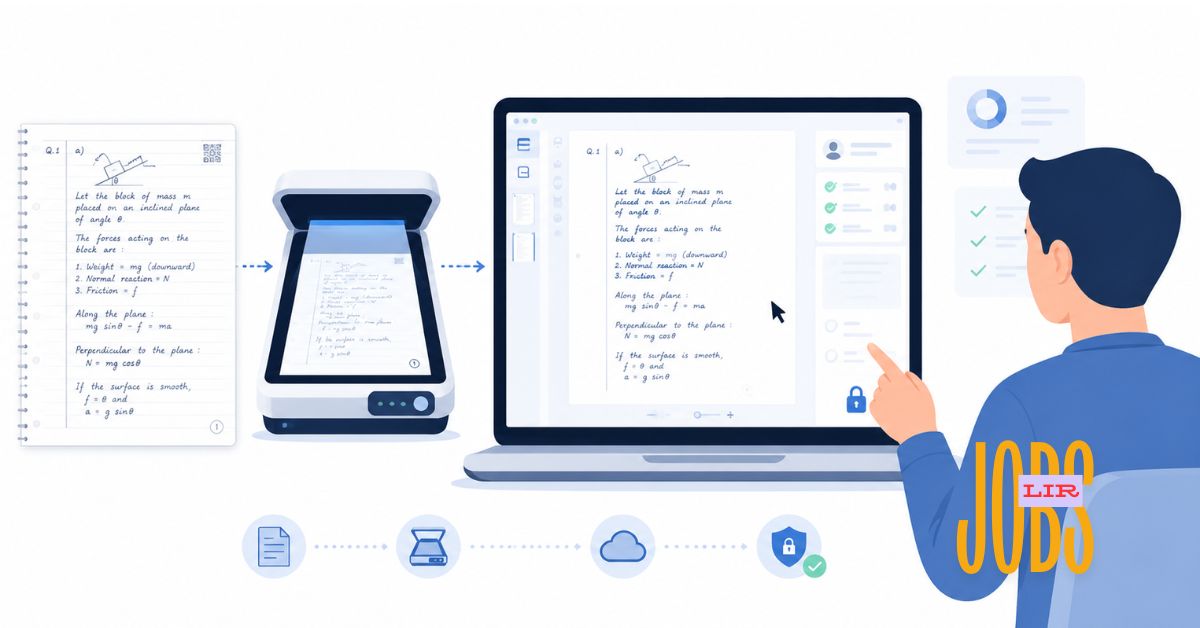
OSM stands for On-Screen Marking. It is a fully digital evaluation method where physical answer sheets are not directly handed to teachers anymore.
Instead, answer sheets are scanned and uploaded online, and examiners evaluate them on a computer screen — not on paper. Think of it as your answer sheet going from your exam hall directly into a computer, and a teacher in a different city reading it on their laptop. That is exactly what happens.
This system has been used internationally by examination boards like Cambridge (UK), IB, and Pearson for years. CBSE has been gradually piloting it and has now implemented it at a larger scale for the 2025–26 session.
So it is not new globally. But it is new at this scale for Indian students — and that is where the confusion begins.
How Does the OSM Process Work? A Step-by-Step Breakdown
Here is exactly what happens to your answer sheet after you submit it:
| Step | Stage | What Happens |
|---|---|---|
| 1 | Scanning | Physical answer sheets are scanned at CBSE-designated centres using high-resolution scanners |
| 2 | Masking | Student identity details — name, roll number — are digitally hidden for anonymous evaluation |
| 3 | Distribution | Scanned copies are allocated randomly to evaluators; one teacher may evaluate papers from students across different cities |
| 4 | Digital Marking | Teachers evaluate on-screen using digital tools, type marks, add annotations, and use a marking scheme displayed alongside |
| 5 | Auto-Totalling | The system automatically calculates the total — eliminating human errors in addition |
| 6 | Quality Audit | Random samples are re-checked by senior evaluators; the system flags papers where marking differs significantly from the average |
(Source: Meri Shiksha, May 2026)
The key idea here is standardisation. One student in Delhi and another in Chennai are evaluated using the same process, the same screen, the same marking scheme — simultaneously.
Why Are Students Upset with the OSM System in 2026?
Here is the real issue. Many students claimed they had performed well, but their results turned out to be around 30 per cent lower than expected.
That is a massive gap. And naturally, panic followed.
Students are now demanding that CBSE should discontinue the On-Screen Marking system.
So what went wrong — or did anything go wrong at all?
Several factors in the OSM process may explain the drop in marks for many students:
- Legibility on screen: Handwriting that looks fine on paper may appear unclear when scanned. Light ink, very small writing, or pencil marks can reduce scan quality.
- Stricter marking scheme: Digital evaluation tools make it easier to apply the marking scheme strictly — there is no room for “benefit of the doubt” when answers are displayed alongside a rigid rubric.
- No margin for presentation: In traditional evaluation, a neatly written paper may create a subtle positive impression. On screen, only content is assessed.
- Teacher unfamiliarity: Some evaluators used the digital tools for the first time, which may have affected consistency in early batches.
CBSE’s Official Stand: “The System Is Transparent”
The CBSE board has clarified that the OSM system was implemented to evaluate the answer sheets of students in a transparent way.
CBSE has defended the OSM evaluation process and advised students to apply for re-evaluation. CBSE has also provided an opportunity for students to get a scanned copy of the evaluated answer book.
In short — CBSE is not backing down. And honestly, from a systemic point of view, they have a fair argument. The OSM process removes a lot of old problems: biased evaluation, manual totalling errors, and regional inconsistency.
But “transparent” and “accurate” are two different things, and that is the part students are pushing back on.
CBSE Class 12 Result 2026 — Key Statistics
Here is a quick look at what the numbers say this year:
| Metric | Data (2026) |
|---|---|
| Girls vs Boys Performance | Girls outperformed boys by 6.73% |
| Highest Pass Rate (Region) | Trivandrum — 95.62% |
| Evaluation Method | On-Screen Marking (OSM) — full scale |
| Re-evaluation Portal Opens | May 19, 2026 |
(Source: Meri Shiksha, May 2026)
What Can You Do If Your Marks Seem Wrong?
CBSE offers a three-step redressal mechanism for students who believe their marks do not reflect their performance. Here it is, clearly laid out:
Step 1 — Verification of Marks (₹500 per subject)
This is a recount. CBSE checks whether all answers were evaluated and whether the totalling is correct. The re-evaluation portal opens on May 19, 2026.
Step 2 — Photocopy of Answer Sheet (₹700 per subject)
You get a scanned copy of your evaluated answer book. This is only available after Step 1. Use this to actually see how marks were awarded for each answer.
Step 3 — Re-evaluation (₹100 per question)
You can challenge specific answers where you believe marking was incorrect. This is only available after Step 2.
Important Warning: Re-evaluation can lead to marks going up, down, or staying the same. Only apply if you are genuinely confident about a specific answer after reviewing the photocopy. The revised marks are final.
OSM vs Traditional Evaluation — A Quick Comparison
| Feature | Traditional (Paper) | OSM (Digital) |
|---|---|---|
| Answer sheet handling | Physical paper | Scanned digital copy |
| Examiner location | Local centres | Can be anywhere in India |
| Identity masking | Sometimes manual | Automatically digital |
| Totalling | Manual (error-prone) | Automatic (system-calculated) |
| Marking scheme display | Printed booklet | On-screen alongside paper |
| Audit mechanism | Manual spot-check | Automated flagging + senior review |
| Transparency for students | Limited | Photocopy available |
The OSM system wins on transparency and scalability. Traditional evaluation wins on familiarity and comfort for both students and teachers. Neither is perfect.
Will OSM Continue in Future CBSE Exams?
Almost certainly yes. OSM is a global best practice and aligns with CBSE’s digitalisation goals. Students preparing for 2027 board exams should assume OSM will be the standard.
So instead of fighting the system, it makes sense to prepare for it.
How to Write OSM-Friendly Answers in Board Exams
Here are practical tips students should follow going forward:
- Use dark blue or black pen — light ink and pencil may not scan clearly
- Write legibly — remember, your answer will be read on a screen, not paper
- Keep spacing consistent — avoid squeezing text into margins
- Follow the marking scheme structure — clear, numbered points work better on screen than long paragraphs
- Avoid overwriting — corrections should be single-line strikethrough, not scribbles
- Write within the box/lines — content outside lines may get cut during scanning
Small habits. Big difference in marks.
Is the OSM System Fair?
This is the honest answer: it depends on how well the system is implemented.
The OSM process itself is fair by design. Anonymous evaluation, automated totals, senior audits — these are good mechanisms. The controversy in 2026 is more about the transition phase than the system being fundamentally flawed.
Students who wrote clearly, followed the marking scheme, and answered to the point likely fared well. Those who wrote in light pencil, used margins excessively, or gave vague paragraph-style answers may have been evaluated more strictly than they expected.
The system is not against you. It just does not give extra credit for effort it cannot measure on a screen.
Key Dates for CBSE Re-evaluation 2026
| Activity | Date |
|---|---|
| CBSE Class 12 Result 2026 Declared | May 2026 |
| Verification of Marks Portal Opens | May 19, 2026 |
| Photocopy Application (after verification) | Post May 19 |
| Re-evaluation Application | Post photocopy receipt |
Always apply through the official CBSE website: cbse.gov.in or via the DigiLocker portal.
Useful External Resources
- CBSE Official Website — cbse.gov.in
- CBSE Results Portal — cbseresults.nic.in
- DigiLocker (for marksheets) — digilocker.gov.in
- Zee News — CBSE OSM Re-evaluation Guidelines — Read here
- India TV News — CBSE Defends OSM — Read here
Frequently Asked Questions (FAQs)
Q1. What does OSM stand for in CBSE? OSM stands for On-Screen Marking. It is a digital evaluation method where answer sheets are scanned and evaluated by teachers on computers.
Q2. Why did CBSE introduce the OSM system? CBSE introduced OSM to make the evaluation process more transparent, reduce manual totalling errors, and eliminate regional inconsistency in marking.
Q3. Can I get my CBSE answer sheet copy under OSM? Yes. You can apply for a photocopy (scanned copy) of your evaluated answer book at ₹700 per subject, but only after applying for verification of marks first.
Q4. Will OSM continue in CBSE 2027 board exams? Based on CBSE’s current direction and the fact that it aligns with global best practices, OSM is very likely to continue in 2027 and beyond.
Q5. Can my marks decrease during CBSE re-evaluation? Yes. Re-evaluation can result in marks going up, staying the same, or going down. Apply only if you are confident about a specific answer after reviewing your photocopy.
Q6. Is the OSM evaluation completely free from errors? No system is 100% error-free. OSM reduces certain errors (like manual totalling mistakes) but introduces new ones (like scanning quality issues). The redressal mechanism exists precisely for this reason.
Q7. How is the OSM system different from traditional CBSE evaluation? In traditional evaluation, physical answer sheets are directly given to teachers. In OSM, sheets are scanned digitally, identities are masked, and teachers evaluate on-screen using a standardised digital marking tool.
Final Thoughts
The CBSE OSM evaluation process is a significant upgrade in how India’s largest school board handles answer scripts. It is not perfect yet — no system in its early large-scale phase ever is. But it is moving in the right direction.
If your marks surprised you this year, do not panic. Use the official redressal process. Review your photocopy before jumping to re-evaluation. And if you are preparing for 2027 boards — write clearly, follow the marking scheme, and keep that pen dark.
Because on a screen, clarity is everything.
Sources: Zee News (May 2026), India TV News (May 2026), Meri Shiksha (May 2026), Shiksha.com (May 2026), CBSE Official Statement (May 2026)
For the latest CBSE updates, always check cbse.gov.in directly.

I am a content creator and SEO-focused writer who shares accurate, easy-to-understand information on government jobs, exams, results, and educational updates to help students make better career decisions.