Table of Contents
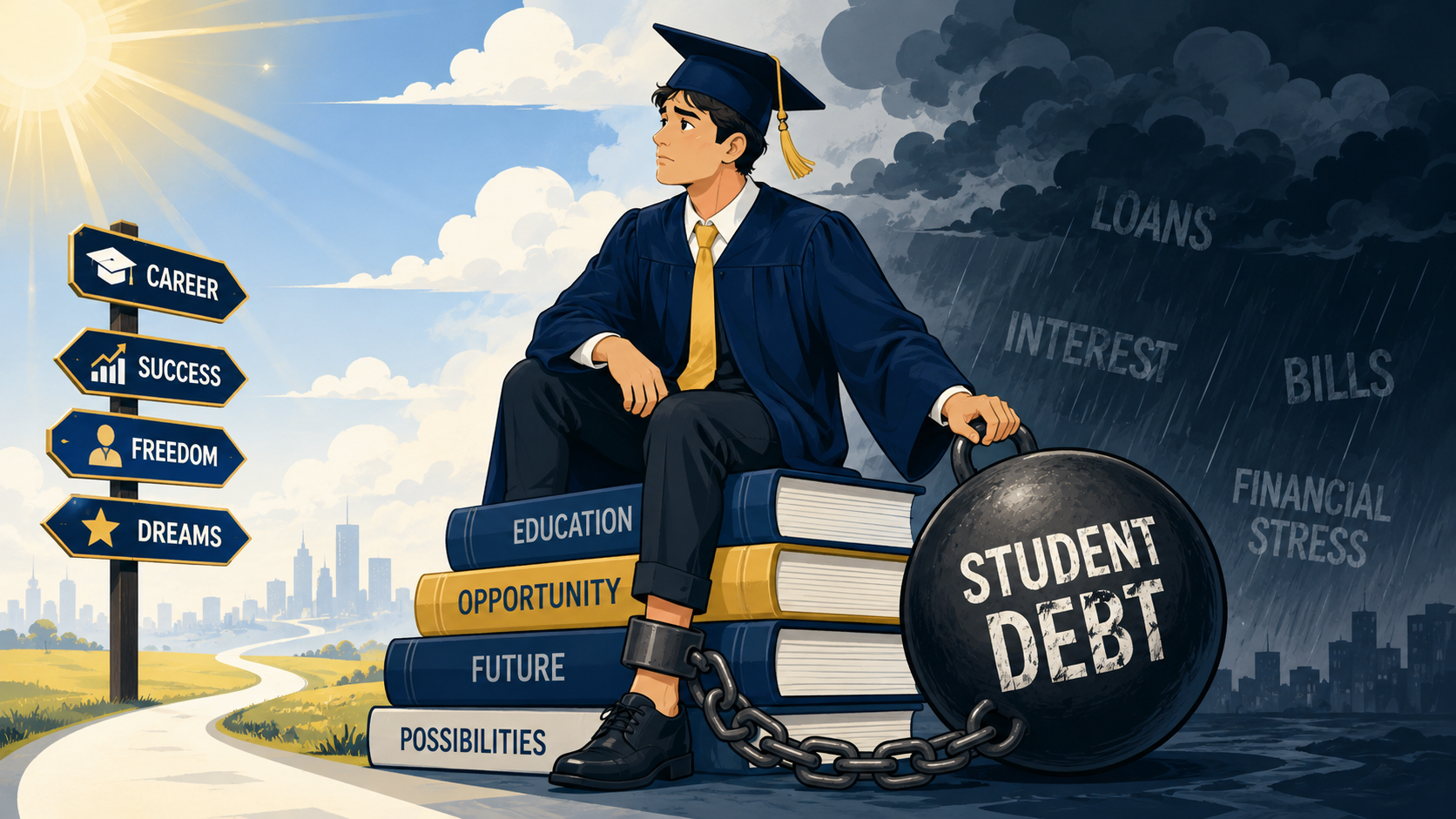
If you’ve ever stared at a student loan statement and thought, “Did I accidentally buy a house I’ll never live in?” — you’re not alone. Millions of Americans are in the same boat. A very expensive, very slow-moving boat.
Student debt in the United States has reached levels that would genuinely shock the people who designed the original federal loan system. And understanding it — really understanding it — is the first step to making smart decisions, whether you’re still in school, just graduated, or have been paying for a decade and still feel like you’re treading water.
This guide covers the real numbers, the real causes, and the real options available to you right now.
The Numbers Are Not Okay: The State of Student Debt in 2025
Let’s get the hard data out of the way first, because the scale of this problem is important context for everything that follows.
Americans now owe $1.87 trillion in combined federal and private student loan debt as of early 2026 — up 3.3% from just one year earlier. That’s not a typo. That’s trillion with a “T,” which puts student loan debt comfortably ahead of all credit card debt in the country.
Here’s a breakdown of what that actually looks like:
Key Student Debt Statistics at a Glance
| Metric | Figure |
|---|---|
| Total U.S. student loan debt (Q1 2026) | $1.87 trillion |
| Federal student loan debt | $1.696 trillion |
| Private student loan debt | ~$140 billion |
| Number of federal loan borrowers | 44.6 million |
| Average federal loan debt per borrower | $39,547 |
| Average bachelor’s degree debt (public uni) | $31,960 |
| Average bachelor’s degree debt (private nonprofit) | $34,420 |
| Delinquency rate (90+ days, Q1 2026) | 10.34% |
Sources: LendingTree Student Loan Statistics, Education Data Initiative, Federal Reserve SHED Report 2024
The delinquency rate deserves a moment of attention. At 10.34%, it’s significantly higher than the 6.16% recorded during the COVID-19 pandemic — a period when most people weren’t even required to make payments. That tells you something real about how much financial pressure borrowers are under right now.
Who Actually Has All This Debt?
Here’s something that surprises a lot of people: it’s not just 22-year-olds fresh out of college struggling with student loans. The debt is spread across age groups in ways that reveal a longer, messier story.
Student Loan Debt by Age Group
| Age Group | Share of Federal Loan Debt |
|---|---|
| Under 25 | 5.56% |
| 25–34 | 29.4% |
| 35–49 | 39.6% |
| 50+ | 25.5% |
Source: Education Data Initiative – Average Student Loan Debt
Nearly a quarter of all federal student loan debt is held by people over 50. Some of that is from their own education. Some of it — about 5% of all adults — comes from loans taken out to help pay for a child or grandchild’s education, according to the Federal Reserve.
The people carrying the most? Borrowers aged 50–61, who hold an average federal loan balance of $46,556. That’s not what anyone pictures when they imagine a “student debtor,” but it’s the reality.
There are also important differences by degree type:
Average Student Debt by Degree Level
| Degree | Average Debt |
|---|---|
| Undergraduate (public institution) | $28,775 |
| Undergraduate (private nonprofit) | $42,449 |
| Master’s degree | $69,140 |
| Law school | ~$140,000 |
| Medical school | ~$200,000 |
| Dental school | ~$296,500 |
Source: Education Data Initiative
Dental school debt of nearly $300,000 is its own category of anxiety. That is a mortgage-level commitment, made before you’ve had your first paycheck.
Why Did Student Debt Get So Out of Control?
This is the question everyone asks, and the answer is genuinely not simple. A few forces came together over the past two decades:
1. Tuition grew much faster than wages. Over the 21st century, college tuition costs have risen at an annual rate of 4.04%, according to Education Data Initiative. Meanwhile, wages for many workers — especially younger ones — didn’t keep pace. The gap between what education costs and what people can reasonably afford to repay grew wider and wider.
2. Federal loan caps on undergrads pushed students toward private loans. When federal subsidized and unsubsidized loan limits weren’t enough, students turned to private lenders, who charge higher interest rates and offer fewer protections.
3. Graduate and professional degrees became more necessary — and more expensive. More jobs require advanced degrees. Law, medicine, business, and education all demand graduate credentials. The borrowing required to get there can be staggering.
4. The system assumed incomes would rise to meet the debt. It often doesn’t work out that way, especially in the first decade of a career.
The federal student loan balance has more than tripled since 2007, when it stood at $516 billion. Today it’s over $1.6 trillion and still climbing.
Federal vs. Private Student Loans: What’s the Difference and Why It Matters
Not all student debt works the same way, and this distinction is critical if you’re making borrowing decisions right now.
Federal vs. Private Loan Comparison
| Feature | Federal Loans | Private Loans |
|---|---|---|
| Share of total debt | ~91% | ~9% |
| Interest rates | Fixed | Fixed or variable |
| Income-driven repayment | Available | Generally not available |
| Loan forgiveness options | Multiple programs | Almost none |
| Deferment/forbearance | Easier to access | Lender-dependent |
| Cosigner requirement | Not required | 96.7% of undergrad loans cosigned |
Sources: LendingTree, Motley Fool Student Loan Research
The single most important thing here: private loans are not eligible for federal forgiveness programs. If you refinance federal loans into private loans to get a lower interest rate, you permanently lose access to income-driven repayment, PSLF, and any future federal relief. Many borrowers have made this trade without fully understanding what they gave up. Think carefully before you do it.
Repayment Options: What’s Actually Available Right Now
The repayment landscape changed significantly in 2025. A law passed on July 4, 2025 restructured several income-driven repayment (IDR) plans, and borrowers need to understand what’s available — and what’s going away.
Current and Upcoming Repayment Plans
| Plan | Status | Key Feature |
|---|---|---|
| IBR (Income-Based Repayment) | Active (staying) | 10-15% of discretionary income; 20-25 year forgiveness |
| ICR (Income-Contingent Repayment) | Being phased out by 2028 | 20% of discretionary income; 25 years |
| PAYE | Being phased out by 2028 | 10% of discretionary income; 20 years |
| SAVE | Ended | Replaced by RAP |
| RAP (Repayment Assistance Plan) | Incoming by 2028 | Replaces SAVE, PAYE, ICR |
Sources: NPR Student Loan Guide, Student Loan Borrowers Assistance
What this means for you: If you were in the SAVE plan — which over 7 million borrowers were — you need to act. The Department of Education will move you to a plan automatically if you don’t choose one, and it may not be the most favorable option for your situation.
Use the official Federal Student Aid Loan Simulator to compare how different plans would affect your monthly payments and total amount paid over time.
Loan Forgiveness: The Programs That Actually Exist
Loan forgiveness is real. It’s also complicated, and the rules have shifted considerably. Here are the main programs worth knowing:
Public Service Loan Forgiveness (PSLF)
PSLF is the most powerful forgiveness program available. It wipes out your entire remaining Direct Loan balance after 120 qualifying monthly payments while working full-time (30+ hours/week) for a qualifying employer — government agencies, 501(c)(3) nonprofits, and some other organizations.
- No income limits, no loan caps
- Average balance forgiven through PSLF: $74,300
- Over 1.22 million borrowers have received forgiveness through PSLF as of early 2026
Important note: As of July 1, 2026, the Department of Education can deny PSLF to workers whose employers engage in activities it defines as having a “substantial illegal purpose.” This is an evolving area — if you’re pursuing PSLF, certify your employment annually and track your progress at StudentAid.gov.
Income-Driven Repayment (IDR) Forgiveness
Under IBR, any remaining balance is forgiven after 20–25 years of qualifying payments. However, there’s a significant catch that trips many people up: IDR forgiveness after 2025 is generally taxable income. If $60,000 is forgiven, the IRS treats it as $60,000 of earned income in that year. Start planning for this tax liability well in advance if you’re on an IDR timeline.
PSLF forgiveness, by contrast, is not taxable.
Teacher Loan Forgiveness
Teachers who work full-time for five consecutive years in a low-income school or educational service agency can qualify for up to $17,500 in forgiveness on certain federal loans. This is separate from PSLF — you can’t use both for the same period of service, but you can strategically sequence them.
Borrower Defense to Repayment
If your school defrauded you or closed while you were enrolled, you may be eligible for loan discharge. This applies specifically to federal Direct Loans and requires an application with documentation.
Source: Federal Student Aid – Forgiveness Programs
How Student Debt Affects Real Life
The weight of student debt doesn’t stay neatly in a loan statement. It follows borrowers into nearly every major life decision.
Research and surveys consistently show that borrowers delay or forgo:
- Buying homes
- Starting families
- Building retirement savings
- Starting businesses
The delinquency data is striking on its own: 10.34% of student loans were 90+ days delinquent in early 2026, up from 7.74% just a year before. That’s a meaningful and fast-moving increase. Delinquencies are now running at roughly double the rate seen during credit card debt crises, according to Motley Fool’s research citing Federal Reserve data.
There are also notable demographic gaps. Black women see their average student loan balance grow 13% over 12 years — a pattern tied to wage gaps and interest accrual. Black and African American students are more likely to borrow (82.9% use federal loans), and they graduate into a labor market that often pays them less, making repayment harder.
These aren’t abstract statistics. They represent delayed retirements, financial stress, and compounding inequality.
7 Practical Steps to Manage Student Debt Smarter
If you’re currently carrying student loan debt, here’s what actually helps:
1. Know exactly what you owe and to whom. Log in to StudentAid.gov to see your complete federal loan picture — balances, interest rates, and servicer information.
2. Compare repayment plans using the official Loan Simulator. Don’t guess which plan works best for your income. Use the tool: studentaid.gov/loan-simulator.
3. Enroll in an income-driven plan if your payment feels unmanageable. Under IBR, payments are generally 10–15% of your discretionary income. Many borrowers qualify for payments significantly lower than the standard plan.
4. If you work in public service, pursue PSLF immediately. Submit an Employment Certification Form to MOHELA (the current PSLF servicer) for every qualifying employer you’ve ever worked for. Retroactive certification counts.
5. Never refinance federal loans into private loans unless you fully understand the tradeoff. You’ll lose all access to federal protections and forgiveness. Run the numbers carefully.
6. Don’t ignore delinquency or default. Contact your servicer before you miss a payment. Deferment and forbearance exist for a reason. Default has severe consequences — wage garnishment, credit damage, tax refund seizure — that are harder to undo than people realize.
7. Plan for the tax consequences of IDR forgiveness. If you’re 10+ years into an IDR plan and have a large remaining balance, talk to a tax professional now. The forgiven amount may create a significant tax bill in the year it’s discharged.
Frequently Asked Questions (FAQ)
Q: What is the average student loan debt in the US? A: The average federal student loan debt is $39,547 per borrower as of 2025. The total average, including private loans, may be as high as $43,333, according to Education Data Initiative.
Q: How many Americans have student loan debt? A: Around 44.6 million Americans hold federal student loan debt as of mid-2025, according to LendingTree’s student loan data.
Q: Is student loan forgiveness taxable? A: PSLF forgiveness is not taxable. IDR forgiveness for loans forgiven after January 1, 2026, is generally treated as taxable income. Teacher Loan Forgiveness is also taxable. Always verify current tax rules with a qualified tax professional.
Q: What is the PSLF program? A: Public Service Loan Forgiveness cancels the remaining balance on your federal Direct Loans after 120 qualifying monthly payments while working full-time for a qualifying government or nonprofit employer. Learn more at studentaid.gov/pslf.
Q: What happens if I default on my student loans? A: Default on federal loans can result in your wages being garnished, your tax refunds seized, your credit score significantly damaged, and loss of eligibility for future federal aid. Contact your loan servicer before missing payments — there are almost always options.
Q: Should I refinance my student loans? A: Only if your loans are private already and you can get a significantly lower interest rate. Refinancing federal loans into private loans permanently removes you from income-driven repayment plans, PSLF, and federal forgiveness programs. This is rarely worth it for most borrowers.
Q: What is the new Repayment Assistance Plan (RAP)? A: RAP is a new income-driven repayment plan being introduced to replace SAVE, PAYE, and ICR by July 2028. It will be the main IDR option alongside IBR for most federal borrowers going forward. Details are still being finalized — monitor studentaid.gov for updates.
Q: Can private student loans be forgiven? A: Generally, no. Private student loans are not eligible for federal forgiveness programs. Some lenders offer hardship programs or settlement options, but these are case-by-case and much more limited.
The Bottom Line
Student debt is one of the most consequential financial decisions millions of Americans make — often at 18, before they have meaningful financial literacy or income. The system, as it exists, places enormous risk on young people and families, and the data shows that risk is translating into real harm.
That said, the options available to borrowers today — income-driven repayment, PSLF, loan forgiveness for educators and public servants — are real and meaningful. The key is knowing what you have, knowing what’s available, and acting on it before deadlines pass.
If there’s one thing this piece is meant to do, it’s this: take the confusion out of a confusing system, so you can make decisions with clear eyes.
For accurate and up-to-date information on your own loans, visit StudentAid.gov. For tax questions related to forgiveness, consult a licensed tax professional.
Data Sources: Federal Reserve, U.S. Department of Education Federal Student Aid, LendingTree, Education Data Initiative, BestColleges, Motley Fool, NPR.

I am a content creator and SEO-focused writer who shares accurate, easy-to-understand information on government jobs, exams, results, and educational updates to help students make better career decisions.