Table of Contents
Introduction
After a gap of almost four years, the Uttar Pradesh Basic Education Board has brought back the Uttar Pradesh Teacher Eligibility Test. If you have been waiting for this exam since 2021, you are not alone. Lakhs of graduates across the state have been checking their phones every morning for this exact update.
So let’s cut through the confusion. This article covers the UPTET 2026 exam date, registration process, eligibility rules, exam pattern, syllabus, and result timeline — all pulled from official notices and verified exam-portal reports. No guesswork, no recycled rumours.
What Is UPTET, And Why Does It Matter?
UPTET is not a job. It is a permission slip.
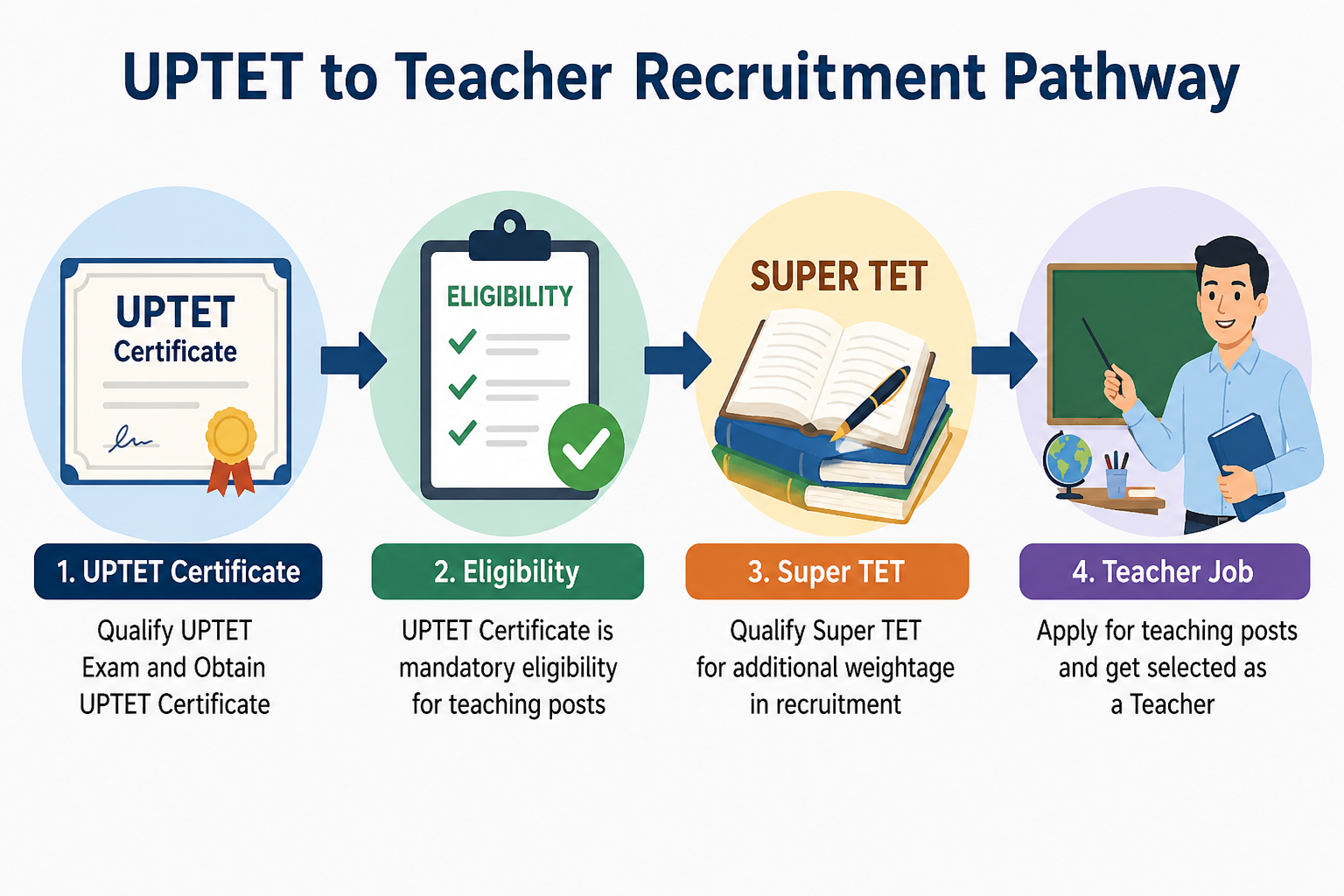
The Uttar Pradesh Teacher Eligibility Test checks whether a candidate is qualified to teach in government and government-aided schools in the state. Passing it does not hand you a teaching post directly. Instead, it gives you a lifetime-valid eligibility certificate, which becomes your entry ticket for future recruitment drives, including the Super TET exam that UP conducts separately for actual appointments.
Think of UPTET as a driving licence and Super TET as the job interview for a delivery company. You need the licence first. Nobody hires a driver without one.
UPTET 2026: Quick Overview
| Detail | Information |
|---|---|
| Full name | Uttar Pradesh Teacher Eligibility Test |
| Conducted by | Uttar Pradesh Basic Education Board (UPBEB), through UPESSC |
| Exam level | State-level teacher eligibility test |
| Notification released | 20 March 2026 |
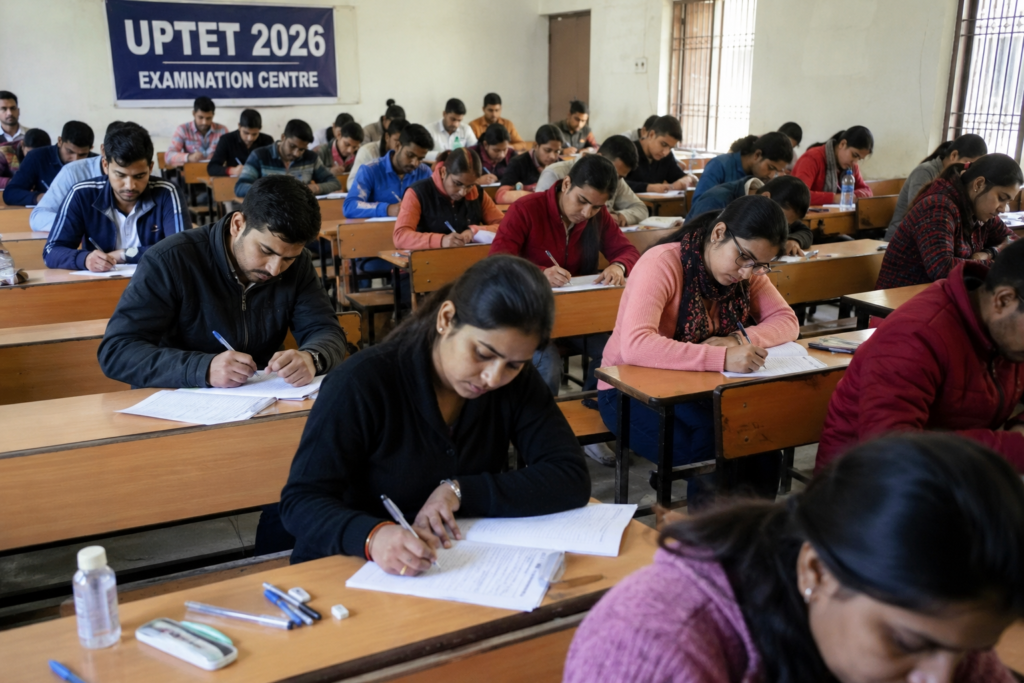
| Exam dates | 2, 3 and 4 July 2026 |
| Mode of exam | Offline (pen and paper) |
| Papers | Paper 1 (Classes 1–5) and Paper 2 (Classes 6–8) |
| Total questions | 150 per paper |
| Total marks | 150 per paper |
| Duration | 2 hours 30 minutes per paper |
| Negative marking | None |
| Qualifying marks | 60% for General/EWS; relaxed for reserved categories |
| Certificate validity | Lifetime |
| Official websites | updeled.gov.in, upessc.up.gov.in |
UPTET 2026 Notification: What Actually Happened
The UPTET notification for 2026 went live on 20 March 2026 on the official portal, updeled.gov.in. This single line carries more weight than it looks. UPTET was last conducted in 2021, and the four-year silence had left a huge backlog of graduates and B.Ed holders waiting for their shot.
The application window opened on 27 March 2026. Reports on the closing date differ slightly across sources — some list 26 April 2026, others mention an extension up to 3 May 2026, with fee correction allowed until 8 May 2026. This is common with large government exams; boards often extend deadlines once traffic on the portal spikes. Always confirm the final date on the official website before you assume you have missed it.
UPTET 2026 Important Dates
| Event | Date |
|---|---|
| Notification release | 20 March 2026 |
| Application form starts | 27 March 2026 |
| Last date to apply (as reported, subject to extension) | Late April to early May 2026 |
| Fee correction window | Up to 8 May 2026 |
| Admit card release | Around 7–10 days before the exam |
| UPTET exam date | 2, 3 and 4 July 2026 |
| Expected result | August 2026 (tentative) |
A quick reality check here: exam boards rarely stick to the first date they announce. Keep this table as a rough map, not a courtroom deadline. The official notification PDF is the only document that overrides everything else.
Who Can Apply? UPTET 2026 Eligibility Criteria
This is the section most candidates rush through and then regret. Read it twice.
Nationality: You must be an Indian citizen. Candidates from Nepal or Bhutan can apply too, but they need an eligibility certificate issued by the Government of India.
Age limit: Generally between 18 and 35 years for the General category, with age relaxation for reserved categories as per state rules.
Educational qualification for Paper 1 (Classes 1–5):
- Graduation with a two-year Diploma in Elementary Education (D.El.Ed), or
- Graduation with a B.Ed degree (as per updated NCTE norms)
Educational qualification for Paper 2 (Classes 6–8):
- Graduation with minimum 50% marks along with B.Ed, or
- Graduation with D.El.Ed, depending on the subject stream
Candidates aiming to teach both primary and upper-primary levels need to appear for both Paper 1 and Paper 2 on the same day, since both are held in the same exam window.
One thing worth repeating for absolute clarity: minimum qualification marks and specific relaxations can shift slightly with every notification cycle. Treat the numbers above as the general framework and verify your personal case against the official PDF, especially if you fall under a reserved category or have a slightly unusual academic background.
How To Apply: UPTET 2026 Registration Process
The application isn’t a single form. It’s a two-step process, and skipping step one is the most common mistake first-time applicants make.
Step 1: One-Time Registration (OTR)
Before touching the actual application form, every candidate must complete OTR. This is an Aadhaar-based process designed to reduce duplicate or fraudulent entries. You do this only once, and it stays valid for other UP state exams too, not just UPTET.
Step 2: Fill The Main Application Form
Once OTR is done, log in and complete the UPTET application form itself — academic details, category, paper selection, exam centre preference, and document uploads.
Step-by-step summary:
- Visit the official website, updeled.gov.in
- Complete One-Time Registration using your Aadhaar details
- Log in with your OTR credentials
- Choose Paper 1, Paper 2, or both
- Fill in academic and personal details carefully
- Upload photograph, signature, and required documents
- Pay the application fee online
- Submit the form and download the confirmation page
Keep a printed or saved copy of your payment receipt and confirmation page. Government exam helplines are famously slow, and a saved receipt saves you weeks of back-and-forth emails later.
UPTET 2026 Exam Pattern: Paper-Wise Breakdown
Both papers are fully objective — multiple choice questions only — and here’s the part candidates actually enjoy: there is no negative marking. One mark per correct answer, zero deduction for a wrong one. That single rule changes exam strategy completely. There’s no reason to leave any question blank.
Paper 1 (Primary Level — Classes 1 to 5)
| Section | Number of Questions | Marks |
|---|---|---|
| Child Development and Pedagogy | 30 | 30 |
| Language I (Hindi) | 30 | 30 |
| Language II (English, Sanskrit, or Urdu) | 30 | 30 |
| Mathematics | 30 | 30 |
| Environmental Studies | 30 | 30 |
| Total | 150 | 150 |
Paper 2 (Upper Primary Level — Classes 6 to 8)
| Section | Number of Questions | Marks |
|---|---|---|
| Child Development and Pedagogy | 30 | 30 |
| Language I (Hindi) | 30 | 30 |
| Language II (English, Sanskrit, or Urdu) | 30 | 30 |
| Mathematics and Science, OR Social Studies | 60 | 60 |
| Total | 150 | 150 |
Duration for each paper is 2 hours 30 minutes. Questions are set roughly at a Class 12 difficulty level, so this is not a test that rewards last-minute cramming — it rewards steady, spread-out preparation.
Suggested inline image: A pie chart or bar graph showing section-wise marks distribution for Paper 1 (alt text: “UPTET Paper 1 marks distribution chart”).
UPTET 2026 Syllabus: What To Actually Study
The syllabus mirrors the exam pattern closely. Here’s the honest breakdown, section by section.
- Child Development and Pedagogy: Learning theories, developmental stages, inclusive education, and teaching methodology. This section is common to both papers and carries strong weight in your final score, so it deserves serious attention rather than a quick skim.
- Language I and Language II: Grammar, comprehension, and teaching pedagogy of the chosen languages.
- Mathematics: Number systems, arithmetic, geometry, and how to teach these concepts to children, not just solve them yourself.
- Environmental Studies (Paper 1 only): Family, food, shelter, water, travel, and basic science-society topics from an NCERT-aligned lens.
- Mathematics and Science, or Social Studies (Paper 2): Candidates pick their stream based on their graduation background.
Because the syllabus leans heavily on NCERT material and pedagogy rather than pure subject depth, candidates with a genuine teaching background usually find this exam more approachable than a typical competitive exam. It rewards understanding “how to teach,” not just “what you know.”
UPTET Qualifying Marks and Category-Wise Cutoff
To be declared UPTET-qualified, candidates generally need:
- 60% marks (90 out of 150) for General and EWS category candidates
- Relaxed marks around 55% for OBC, SC, ST, and PwBD category candidates, as per state reservation policy
These figures follow the pattern used in earlier UPTET cycles and current 2026 exam reporting. The board’s official answer key and result notice remain the final word, so treat this as a strong estimate rather than a guaranteed number until results are declared.
UPTET 2026 Admit Card
The admit card is expected roughly 7 to 10 days before the exam date, released on the official UPBEB/UPDELED portal. Here’s how to download it once it’s live:
- Go to updeled.gov.in
- Click on the “Admit Card / Download Hall Ticket” section
- Enter your registration number and date of birth
- Complete the captcha verification
- Download the admit card in PDF format
- Take a clear printout for your exam day
No candidate is allowed inside the exam hall without a valid printed admit card and a government-approved photo ID. This sounds obvious, but every single exam season, someone gets turned away at the gate for forgetting this. Don’t be that person.
UPTET Result 2026: When To Expect It
Based on current board planning, the UPTET 2026 result for both papers is expected around August 2026, though this remains tentative until officially confirmed. Once released, candidates can check their scorecard using their registration number and date of birth on the official website.
Qualified candidates receive a UPTET eligibility certificate that, as per the current rule, is valid for a lifetime. This is a meaningful change from earlier years, when the certificate expired after five years and candidates had to reappear repeatedly just to stay eligible.
UPTET vs Super TET: Don’t Mix These Up
This confuses a lot of first-time applicants, so let’s settle it clearly.
| Point | UPTET | Super TET |
|---|---|---|
| Purpose | Eligibility test only | Actual recruitment exam |
| Result | Pass or fail with certificate | Merit list for job selection |
| Validity | Lifetime | Specific to that recruitment cycle |
| Next step after clearing | Eligible to apply for teaching jobs | Direct appointment process |
In short: UPTET opens the door. Super TET decides who actually walks through it. You cannot skip UPTET and jump straight to Super TET — the certificate is a mandatory prerequisite.
Quick Preparation Tips (Backed By The Exam’s Own Rules)
- Since there’s no negative marking, attempt every single question. An educated guess costs you nothing.
- Give Child Development and Pedagogy the attention it deserves — it appears in both papers and is often underestimated.
- Stick to NCERT textbooks from Class 1 to Class 8 for concept clarity; the syllabus is built directly on this foundation.
- Practice with previous years’ UPTET papers to get familiar with the question style and time pressure.
- Revise, don’t just read. A 2-hour 30-minute paper with 150 questions leaves you roughly one minute per question, so speed matters as much as accuracy.
Frequently Asked Questions
1. When is the UPTET 2026 exam?
The exam is scheduled for 2, 3, and 4 July 2026.
2. Is UPTET a job or only an eligibility exam?
It is only an eligibility test. Clearing UPTET makes you eligible to apply for teaching positions; actual recruitment happens through separate exams like Super TET.
3. Is there negative marking in UPTET 2026?
No. One mark is given for every correct answer, and there is no deduction for wrong or unattempted answers.
4. What are the qualifying marks for UPTET 2026?
Generally 60% for General and EWS candidates, with relaxed marks for reserved categories, following the pattern of earlier UPTET cycles.
5. How long is the UPTET certificate valid?
As per the current rule, it is valid for a lifetime.
6. Can I apply for both Paper 1 and Paper 2?
Yes. If you want to be eligible to teach Classes 1 to 8, you can appear for both papers, usually on the same day.
7. Where do I apply for UPTET 2026?
Applications are submitted online through the official website, updeled.gov.in.
8. Is One-Time Registration (OTR) compulsory?
Yes. OTR is mandatory and must be completed before filling the main UPTET application form.
Official Sources and Further Reading
- UP Basic Education Department – Official Portal (updeled.gov.in)
- Uttar Pradesh Education Service Selection Commission (upessc.up.gov.in)
Always cross-check exam dates, fee details, and eligibility conditions directly on these official portals before making any preparation or travel decisions. Third-party exam news sites, including this article, summarise official notices for convenience — but the notification PDF released by UPBEB and UPESSC remains the single source of truth.
This article reflects information available as of August 2026, based on the official UPTET 2026 notification and updates reported through verified education-news portals. Exam dates and cutoffs can be revised by the board; readers are advised to confirm final details on the official website before applying.

I am a content creator and SEO-focused writer who shares accurate, easy-to-understand information on government jobs, exams, results, and educational updates to help students make better career decisions.