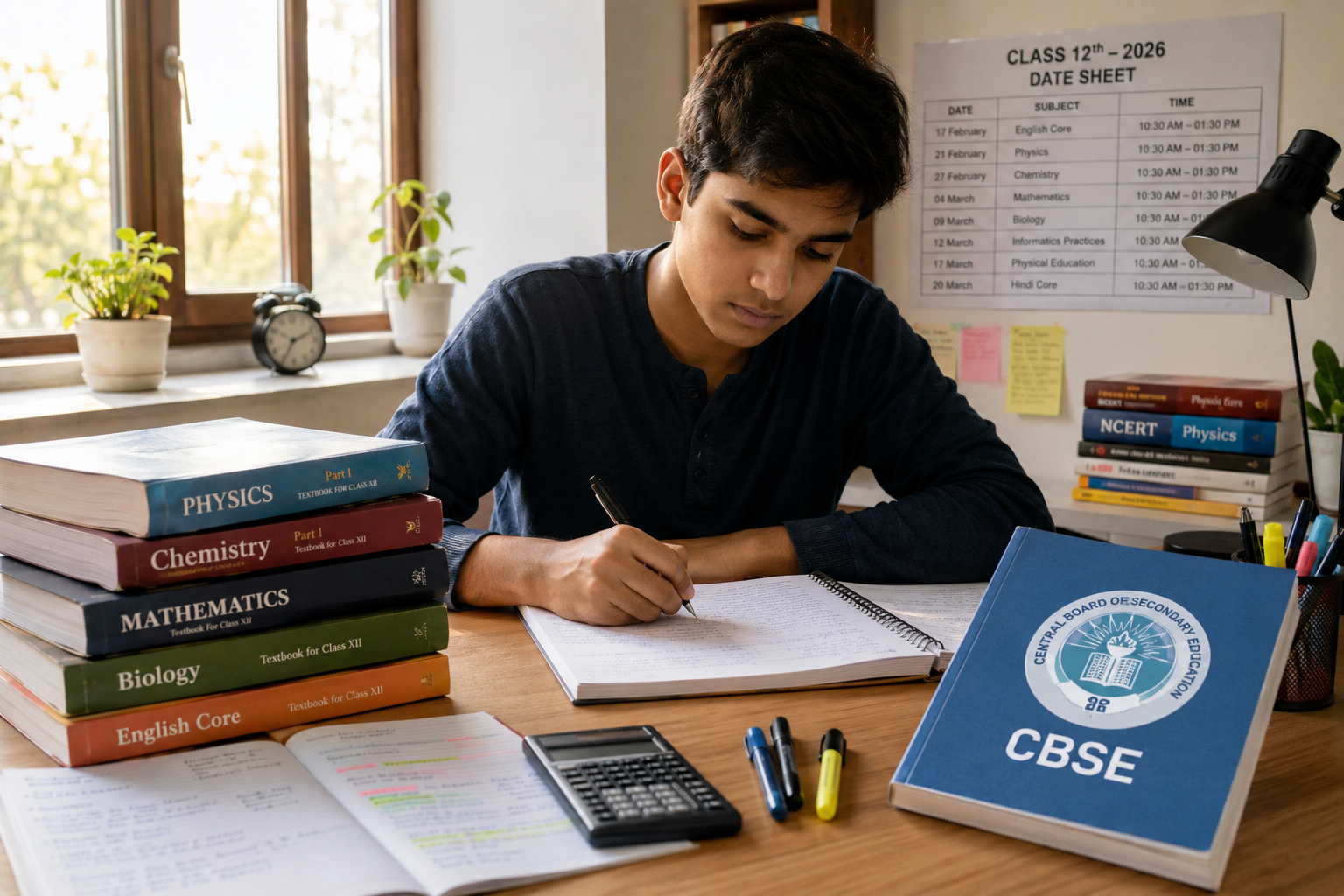
What is the CBSE Class 12 Board Exam?
The CBSE Class 12 Board Examination is one of the most important academic milestones in a student’s life in India. Conducted by the Central Board of Secondary Education (CBSE), this exam determines not just your school performance — it shapes your college admissions, career path, and in many ways, your confidence as a student.
Every year, more than 17 lakh students appear for this exam from thousands of schools across India and 26 other countries. That is a massive number — and yet, every single one of those students has to sit in that exam hall with just a pen, an answer book, and three hours to show what they know.
Quick Fact: The CBSE Class 12 result plays a significant role in university admissions for courses like Engineering (JEE), Medicine (NEET), Law, Commerce, and Arts. Your board score is not “just another exam” — colleges still weigh it heavily.
The board follows the guidelines of the National Education Policy (NEP) 2020, which now emphasises skill-based and competency-driven assessment over rote memorisation. So if you were planning to just cram NCERT chapters, sorry — the exam now wants you to think, not just remember.
The good news? With a clear plan and the right approach, scoring 90%+ is genuinely achievable. This guide will show you exactly how.
Exam Dates & Important Schedule 2025-26
The CBSE Class 12 exams for the academic year 2025-26 are scheduled to run from February 17 to April 9, 2026. All papers will be held in the morning session from 10:30 AM to 1:30 PM in pen-and-paper format.
Important: Practical exams for Class 12 begin from February 15, 2025. These are conducted internally by your school and carry 20–30 marks depending on the subject. Do not take practicals lightly — they are free marks waiting to be picked up.
Missing an exam or arriving late can lead to consequences that no student wants to deal with. Plan your travel to the exam centre with extra time — aim to reach at least 30 minutes before the paper begins.
Exam Pattern & Question Types Explained
The CBSE Class 12 exam pattern for 2025-26 has gone through meaningful changes. CBSE introduced a new structure in April 2024 which shifted the focus toward competency-based learning. In plain terms: they want to know if you can apply knowledge, not just recall it.
General Paper Structure (Most Subjects)
| Question Type | Weightage | Nature |
|---|---|---|
| MCQ / Case-Based (Objective) | 20% | Multiple choice, 1 mark each |
| Competency-Based Questions | 50% | Case/source-based, application-focused |
| Constructed Response (Short/Long Answers) | 30% | Traditional written answers, 2–5 marks |
Key Change in 2025-26: The weightage for competency-based questions (MCQs, case/source-based) increased to 50% from the previous 40%. Constructed response questions dropped from 40% to 30%. This means you need to develop reasoning skills, not just write long answers.
Exam Overview at a Glance
| Detail | Information |
|---|---|
| Conducting Authority | Central Board of Secondary Education (CBSE) |
| Mode of Exam | Offline — Pen and Paper |
| Duration | 3 Hours per paper |
| Total Marks per Subject | 100 (Theory + Practical / Internal Assessment) |
| Internal Assessment | 20 marks (conducted by school) |
| Minimum Passing Marks | 33% in each subject and in aggregate |
| Percentage Calculation | Best of 5 subjects rule applies |
| Official Website | cbse.gov.in |
Theory vs Practical Split (Science Stream)
| Subject | Theory Marks | Practical Marks | Total |
|---|---|---|---|
| Physics | 70 | 30 | 100 |
| Chemistry | 70 | 30 | 100 |
| Biology | 70 | 30 | 100 |
| Mathematics | 80 | 20 (Internal) | 100 |
| English Core | 80 | 20 (Internal) | 100 |
Marking Scheme & Marks Distribution
Understanding how marks are distributed across units and chapters can genuinely change how you study. Why spend equal time on a 3-mark chapter and a 12-mark chapter? That does not make strategic sense.
Mathematics — Chapter-wise Weightage
| Unit | Chapter | Marks |
|---|---|---|
| Relations & Functions | Relations and Functions, Inverse Trigonometry | 8 |
| Algebra | Matrices, Determinants | 10 |
| Calculus | Continuity, Integrals, Diff. Equations, Applications | 35 |
| Vectors & 3D | Vectors, Three-Dimensional Geometry | 14 |
| Linear Programming | Linear Programming | 5 |
| Probability | Probability | 8 |
| Total Theory | 80 | |
Physics — Unit-wise Weightage
Grading System
| Marks Range (%) | Grade | Grade Point |
|---|---|---|
| 91–100 | A1 | 10.0 |
| 81–90 | A2 | 9.0 |
| 71–80 | B1 | 8.0 |
| 61–70 | B2 | 7.0 |
| 51–60 | C1 | 6.0 |
| 41–50 | C2 | 5.0 |
| 33–40 | D | 4.0 |
| Below 33 | E (Fail) | — |
Best of 5 Rule: CBSE calculates your final percentage using your top 5 subject scores. If you appear in 6 subjects, the lowest-scoring subject gets dropped automatically. Use this rule to your advantage.
Subject-Wise Preparation Tips
Every subject has its own personality. Physics does not behave like History. Chemistry does not study itself the same way English does. Here is what you actually need to know for each major subject.
⚛️ Physics
Master derivations and formulae. Write SI units for every answer. Solve NCERT examples and exercises fully. Previous year numericals from Optics and Electrostatics repeat often. Practice at least 3 papers in timed conditions.
🧪 Chemistry
Inorganic Chemistry is pure NCERT — do not skip a single reaction. For Organic, write reactions repeatedly until they flow naturally. Physical Chemistry needs numerical practice. Metallurgy is frequently tested — read it carefully.
🧬 Biology
NCERT is your Bible for Biology. Learn all diagrams — they carry direct marks. Genetics, Biotechnology, and Ecology are high-weightage units. Write definitions in your own words; do not memorise verbatim without understanding.
📐 Mathematics
Calculus carries 35 marks — it is the most important unit by far. Do not skip any chapter, even low-weightage ones, as they can carry 4-mark long questions. Speed and accuracy together win in Maths.
📝 English Core
Format matters as much as content. Practice “Job Application” and “Article” writing with proper box format and underlining. Reading Comprehension requires active reading speed. Literature answers should be specific, not vague.
💰 Accountancy
Practice journal entries and balance sheets daily. Numericals must be practised until they become automatic. CBSE removed the pre-printed table format for Accountancy — write all tables manually now.
Study Hours: A Realistic Daily Plan
| Time Block | Activity | Duration |
|---|---|---|
| 6:00–8:00 AM | Fresh concept study (difficult subjects) | 2 hours |
| 9:00–12:00 PM | School / self-study revision | 3 hours |
| 2:00–4:00 PM | Practice questions and numericals | 2 hours |
| 5:00–6:00 PM | Break / outdoor activity / rest | 1 hour |
| 7:00–9:00 PM | Revision + sample papers | 2 hours |
| 9:30–10:00 PM | Quick review of the day’s notes | 30 mins |
Expert guidance from Aakash Institute: Students should first complete NCERT theory, solved examples, and exercises before moving to any reference book. NCERT covers approximately 60–70% of the weightage in the board exam.
Topper Strategy: How to Score 95%+
Every topper you read about in the newspapers did not wake up in February and decide to study hard. Their journey started months — sometimes more than a year — before the exam. Here is the honest breakdown of what separates a 95% student from a 75% student.
- Start Early, Finish Syllabus by January. Toppers complete their full CBSE Class 12 syllabus by the end of January at the latest. This gives them a full month for revision before exams begin in mid-February. If you are still doing first-time reading in January, you are behind. Start now.
- NCERT First, Always. Almost every board exam question — especially for Biology, Chemistry, and Physics — is directly or closely based on NCERT. Toppers master NCERT thoroughly before touching any reference book. They read examples, not just exercises.
- Write Your Answers, Do Not Just Read. Reading notes gives you the illusion of learning. Writing answers — especially in timed conditions — builds real exam skill. Toppers write multiple sample answers and then compare them with the marking scheme.
- Solve Previous Year Papers Strategically. The last 10 years of CBSE board papers reveal patterns. Certain topics appear every single year. Toppers identify these high-frequency questions and ensure they can answer them perfectly every time.
- Take Internal Marks Seriously. Practicals and projects carry 20–30 marks per subject. That is free score on the table. A student who takes practicals seriously has a built-in head start over someone who does not.
- Revise Three Times Minimum. One reading is for understanding. Two readings are for retention. Three readings are for exam confidence. Toppers revise the same material multiple times using techniques like spaced repetition and active recall.
- Use Sample Papers from CBSE Official Website. CBSE releases official sample papers and marking schemes on cbse.gov.in every academic year. These papers mirror the actual exam pattern almost exactly. Use them — they are free and they are official.
- Analyse Mistakes Without Emotions. After every mock test, toppers review wrong answers calmly and systematically. They identify whether the mistake was due to a concept gap, a careless error, or a time management issue — and fix that specific problem.
What Competency-Based Questions Actually Mean for Your Prep
Since 50% of your paper now consists of competency-based questions, you need to move beyond just knowing facts. These questions present a real-world scenario or a source passage and ask you to apply your knowledge to it.
For example, in Physics, instead of asking “What is Ohm’s Law?” they may give you a circuit diagram with unfamiliar values and ask you to interpret the results. This tests whether you actually understand the concept or simply memorised the definition.
The best way to prepare for these questions is to solve CBSE’s official sample papers and practice case-based questions from the academic portal at cbseacademic.nic.in.
Exam Day Tips — What Toppers Actually Do
Here is a truth that not enough people talk about: your performance on exam day is not just about what you studied. It is about how you show up — mentally and physically — on that specific morning.
- Sleep for at least 7–8 hours the night before. No last-minute cramming after 10 PM.
- Eat a light, familiar breakfast. Exam day is not the time to try something new.
- Reach the exam centre at least 30 minutes early. Rushing increases anxiety and costs focus.
- Read the entire question paper in the first 15 minutes (reading time). Plan which questions to attempt first.
- Start with questions you are most confident about. This builds momentum and reduces stress early in the paper.
- Underline key terms in your answer and use subheadings where relevant. Neat presentation gets better marks.
- Allocate time wisely. Do not spend 20 minutes on a 3-mark question when you have 8-mark questions pending.
- Never leave the exam hall early. Use every remaining minute to re-check answers — a quick review can pick up marks you missed.
- Do not discuss the paper with friends immediately after. Comparing answers triggers unnecessary anxiety before the next exam.
- Items NOT allowed inside the exam hall: mobile phones, smartwatches, earphones, printed material, or any electronic device.
New in 2026 — On-Screen Marking (OSM): CBSE has introduced on-screen marking for Class 12 board exams. Your answer sheets will be scanned and evaluated digitally. This means neat, well-spaced writing and clear page numbering matter more than ever. Write legibly.
What to Carry to the Exam Hall
| Carry This | Do NOT Carry This |
|---|---|
| Admit card (printed) | Mobile phone or smartwatch |
| Blue/black ballpoint pens (2–3) | Bluetooth earpiece |
| Geometry box (for relevant subjects) | Printed notes or textbooks |
| Valid school ID card | Electronic calculator (unless permitted) |
| Water bottle (transparent) | Any smart device |
Best Resources & Important Links
There is no shortage of study material online — the problem is filtering out the noise and finding resources that are actually aligned with CBSE’s official syllabus and pattern. Here are the most reliable ones.
Recommended Books Beyond NCERT
| Subject | Reference Book | Best For |
|---|---|---|
| Mathematics | RD Sharma / Arihant All-in-One | Extra practice, higher-order questions |
| Physics | HC Verma (Concepts of Physics) | Deep concept understanding + numericals |
| Chemistry | OP Tandon / NCERT Exemplar | Organic Chemistry, extra MCQs |
| Biology | Trueman’s Biology | Diagrams, additional information |
| English | CBSE Sample Papers + Oswaal | Format practice, writing skills |
| Accountancy | DK Goel / TS Grewal | Numerical practice and problem sets |
Frequently Asked Questions (FAQ)
These are the most common questions students and parents ask about CBSE Class 12 board exams. Real answers, no padding.
📚 Sources & References
- Central Board of Secondary Education — Official Website: cbse.gov.in
- CBSE Marking Scheme Portal: cbse.gov.in/marking-scheme
- ALLEN Institute — CBSE Class 12 Exam Pattern 2025-26: allen.in
- CollegeDunia — CBSE Class 12 Exam Pattern 2026: collegedunia.com
- Vedantu — CBSE Class 12 Marking Scheme 2025-26: vedantu.com
- Aakash Institute — Topper Strategies Class 12 Boards 2026: aakash.ac.in
- GetMyUni — CBSE Class 12 Exam Pattern 2025-26: getmyuni.com
- BusinessToday — CBSE Marks Distribution 2025: businesstoday.in
Last reviewed: May 2026 | Source: cbse.gov.in | For official notifications always refer to CBSE directly.

I am a content creator and SEO-focused writer who shares accurate, easy-to-understand information on government jobs, exams, results, and educational updates to help students make better career decisions.