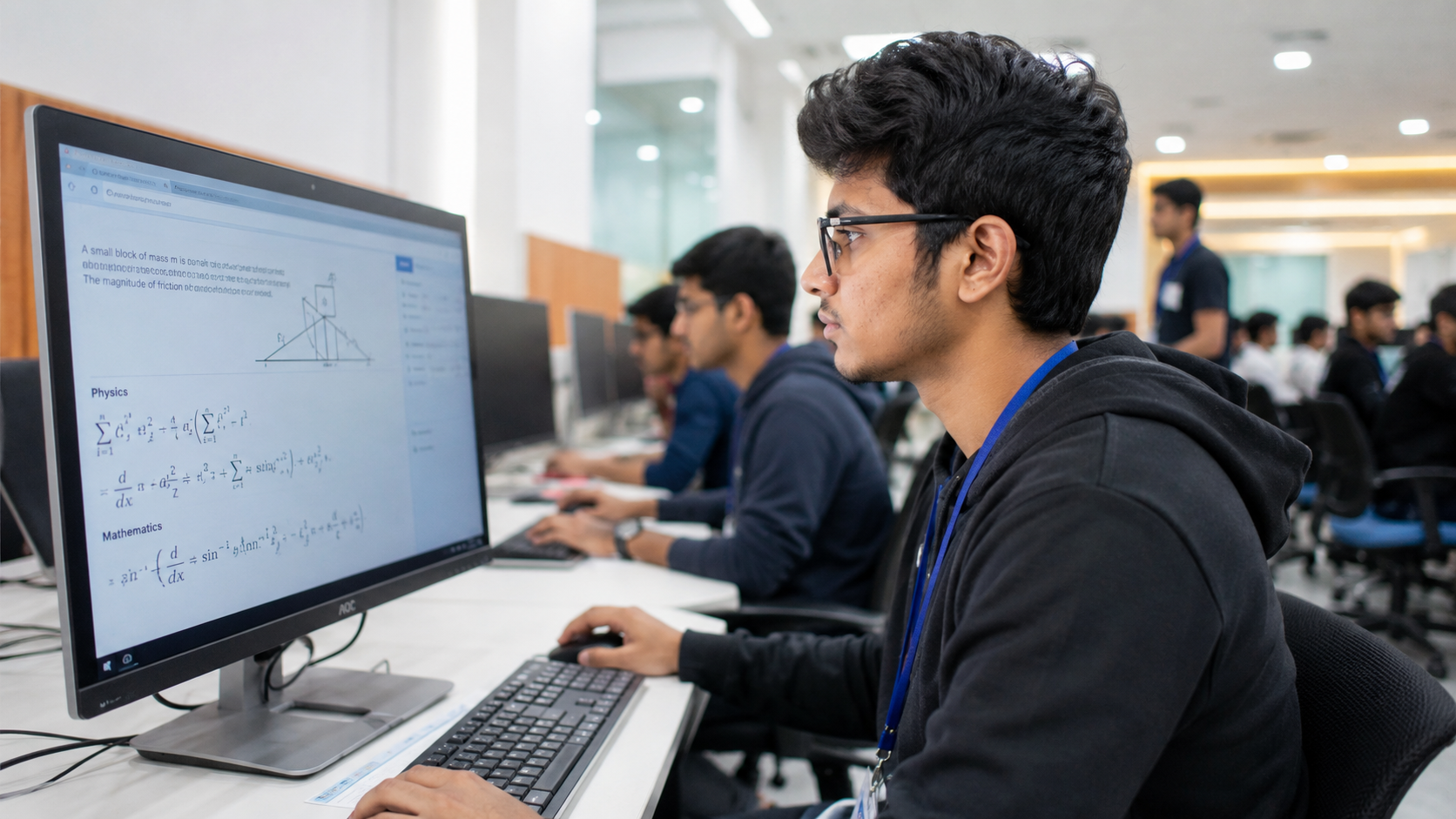
JEE Advanced 2026: Everything You Need to Know Before Exam Day
Dates, eligibility, syllabus, exam pattern, preparation strategy — all in one place. No fluff. Just facts.
📋 Table of Contents
What Is JEE Advanced?
Think of JEE Main as the audition and JEE Advanced as the final stage performance — except here, the stakes are an IIT seat.
The Joint Entrance Examination (Advanced), commonly known as JEE Advanced, is India’s gateway to the Indian Institutes of Technology (IITs). It is widely regarded as one of the most challenging undergraduate engineering entrance exams in the world.
The exam has a rich history going back to 1961 when it was first conducted as the Common Entrance Exam (CEE). In 2013, the familiar IIT-JEE was rebranded and split into two stages — JEE Main and JEE Advanced — giving the current structure we know today.
The exam is organised on a rotation basis among seven zonal IITs: IIT Roorkee, IIT Kharagpur, IIT Delhi, IIT Kanpur, IIT Bombay, IIT Madras, and IIT Guwahati. For 2026, IIT Roorkee is the organising institute.
JEE Advanced 2026: Important Dates
Mark these dates. Miss one, and months of preparation could go to waste. IIT Roorkee has officially published the complete schedule on jeeadv.ac.in.
| Event | Date |
|---|---|
| Registration Opens (JEE Main Qualified) | April 23, 2026 |
| Registration Opens (Foreign Nationals / OCI/PIO) | April 6, 2026 |
| Last Date for Form Submission | May 2, 2026 |
| Last Date for Application Fee Payment | May 4, 2026 |
| Admit Card Available for Download | May 11 – May 17, 2026 |
| JEE Advanced Exam Date | May 17, 2026 (Sunday) |
| Provisional Answer Key Released | May 25, 2026 |
| Last Date to File Objections | May 26, 2026 |
| Final Answer Key and Result Declared | June 1, 2026 |
| JoSAA Counselling Begins | June 2, 2026 |
Eligibility Criteria for JEE Advanced 2026
Clearing JEE Main is just the first ticket in — the eligibility rules for JEE Advanced go much deeper.
You must fulfil all the following conditions to be eligible. Missing even one is grounds for disqualification, so read carefully.
Performance in JEE Main
Candidates must be among the top 2,50,000 successful candidates (across all categories) in the JEE Main B.E./B.Tech Paper 1. The category-wise breakdown is as follows: 10% for GEN-EWS, 27% for OBC-NCL, 15% for SC, 7.5% for ST, and 40.5% OPEN for all. Within each category, 5% horizontal reservation applies for PwD candidates.
Class XII Criteria
A candidate must have appeared for Class XII (or equivalent) for the first time in either 2025 or 2026. Candidates who appeared in Class XII for the first time in 2024 or earlier are not eligible. Physics, Chemistry, and Mathematics must be compulsory subjects. Candidates also need a minimum of 75% aggregate marks (65% for SC/ST/PwD).
Age Limit
Candidates must be born on or after October 1, 2001. SC, ST, and PwD candidates get five years of relaxation, meaning they must be born on or after October 1, 1996.
Number of Attempts
A candidate can attempt JEE Advanced a maximum of two times in two consecutive years. So if you sat for JEE Advanced in 2025, you have one more attempt in 2026.
IIT Admission History
Candidates who have previously been admitted to an IIT — including those whose admission was later cancelled — are generally not eligible. There are specific exceptions; always check the official brochure at jeeadv.ac.in.
JEE Advanced 2026: Exam Pattern
The exam is a Computer-Based Test (CBT) split into two mandatory papers on the same day. Think of Paper 1 as the morning warm-up and Paper 2 as the afternoon test of endurance. You need to sit for both — skipping one means automatic disqualification.
| Detail | Paper 1 | Paper 2 |
|---|---|---|
| Timing | 9:00 AM – 12:00 Noon | 2:00 PM – 5:00 PM |
| Duration | 3 Hours | 3 Hours |
| Subjects | Physics, Chemistry, Maths | Physics, Chemistry, Maths |
| Mode | Computer Based Test | Computer Based Test |
| Languages | English & Hindi | English & Hindi |
| Question Types | MCQ, MSQ, Numerical | MCQ, MSQ, Numerical |
| Negative Marking | Yes (for select MCQs) | Yes (for select MCQs) |
Syllabus Overview: What You Need to Master
The syllabus pulls from Class XI and XII — but the questions test far more than textbook memorisation.
A revised syllabus was adopted in November 2021 and has been in effect from 2023 onwards. Below is a quick look at the core topics across the three subjects. For the full official syllabus, visit jeeadv.ac.in.
⚛️ Physics
- Mechanics & Kinematics
- Electricity & Magnetism
- Optics & Wave Motion
- Modern Physics
- Thermodynamics
- Simple Harmonic Motion
🧪 Chemistry
- Organic Chemistry
- Inorganic Chemistry
- Physical Chemistry
- Electrochemistry
- Chemical Equilibrium
- Coordination Compounds
📐 Mathematics
- Calculus (Differential & Integral)
- Algebra & Complex Numbers
- Vectors & 3D Geometry
- Trigonometry
- Probability & Statistics
- Matrices & Determinants
Category-wise Seat Distribution
Out of the top 2,50,000 JEE Main qualifiers allowed to register for JEE Advanced, here is how they are split across categories:
Within each of these five categories, a further 5% horizontal reservation is available for PwD (Persons with Disability) candidates.
Preparation Tips That Actually Work
Every year, thousands of students prepare hard but prepare wrong. Here is what genuinely works.
Roughly 13 lakh students appear in JEE Main each year. Out of those, only 2.5 lakh make it to JEE Advanced. And from JEE Advanced, approximately 48,000 students qualify for IIT admissions. That means cracking JEE Advanced places you in the top 0.4% of all engineering aspirants in India. The competition is real, but so is the strategy.
Start With Conceptual Clarity, Not Speed
JEE Advanced is not a test of how fast you can recall. It tests whether you truly understand concepts well enough to apply them in new, unfamiliar scenarios. Students who memorise shortcuts often hit a wall at this stage. Build your foundation first.
Subject-Specific Advice
- Physics — This subject rewards problem-solving over theory. Start with easier problems, then scale up. Do not neglect topics like Modern Physics and Optics — they are consistent scorers.
- Chemistry — Organic Chemistry requires logical thinking. Inorganic Chemistry needs consistent revision. Physical Chemistry lives and dies by your mastery of formulas and their correct application.
- Mathematics — Maths options in JEE Advanced are often deliberately close to each other. Careless calculation mistakes are killers here. Know your formulas, but understand derivations too.
Mock Tests Are Non-Negotiable
IIT Roorkee has made free mock tests available for JEE Advanced 2026. Take them seriously. Treat each mock test like the real exam — full timing, no interruptions. Use the results diagnostically, not emotionally.
Time Management Inside the Exam Hall
You have three hours per paper. That is roughly 36 minutes per subject in Paper 1 if you split evenly — though most aspirants allocate dynamically based on strength. The key rule: never spend more than 4 minutes on a question before moving on and returning later.
Application Fee (2026)
| Category | Application Fee |
|---|---|
| Indian Female Candidates / SC / ST / PwD | ₹1,600 |
| All Other Indian Candidates (General / OBC-NCL / EWS) | ₹3,200 |
| Foreign Nationals (SAARC Countries) | USD 75 |
| Foreign Nationals (Non-SAARC Countries) | USD 150 |
What Happens After JEE Advanced?
Cracking JEE Advanced is the beginning, not the end. Here is what follows:
JoSAA Counselling (Joint Seat Allocation Authority) begins the very next day after results — June 2, 2026. This is where IIT seats are actually allocated based on your JEE Advanced rank, category, and course preferences. You will go through multiple rounds of seat allotment.
Apart from IITs, your JEE Advanced score also opens doors to institutions like IISc Bengaluru, IISERs, IIST Thiruvananthapuram, RGIPT Rae Bareli, and IIPE Visakhapatnam. So even if your rank is not high enough for your dream IIT branch, you still have strong options.
Frequently Asked Questions (FAQ)

I am a content creator and SEO-focused writer who shares accurate, easy-to-understand information on government jobs, exams, results, and educational updates to help students make better career decisions.